

Two identical 4 × 3 m pergolas from the same catalogue. The same price, the same “reinforced profile”. One stands near Zielona Góra, the other near Suwałki. In January the first carries around 700 kg of snow, the second over 1 500 kg. The catalogue does not mention it, because the catalogue does not know where you live. The standard does. And this part is about the standards: not so that you calculate it yourself, but so that you know what to ask before you sign.
This is the first of three articles in the series “Before you buy, ask the supplier”. Today: where the numbers come from. Next week: what those numbers do to the structure, using a real FEA analysis as an example. In two weeks: a checklist of 15 questions to take to every supplier of pergolas, patio roofs or carports.
Where the numbers come from: three standards working for you
A patio roof is a building structure. It does not matter that it is light, made of aluminium and “only for the patio”. The same design rules apply to it as to the roof of a house, just on a smaller scale. In Poland they are described by the Eurocodes, that is, the PN-EN series of standards, specifically:
- PN-EN 1990 sets out how to combine loads and what safety margin to apply,
- PN-EN 1991-1-3 says how much snow will fall on a roof at a given place in Poland,
- PN-EN 1991-1-4 says how hard the wind blows and in which direction it acts on a roof,
- PN-EN 1999-1-1, that is Eurocode 9, says how much a specific aluminium profile can take.
Each of these standards has a National Annex. It contains the snow and wind zone maps for Poland. That is why a manufacturer’s catalogue from the Netherlands or Turkey cannot tell you whether its pergola will withstand winter in Suwałki. Only someone who has entered your address into the standard can tell you that.
Snow: five zones, one address
Let us start with the figure called s_k. This is the characteristic ground snow load: how much snow, expressed in kilograms per square metre, may lie on the ground in your area in an exceptionally snowy winter. Not every winter. One that statistically occurs once in 50 years. The standard designs for that bad winter, not for an average one.
Poland is divided into five zones. The value increases from west to east and with altitude above sea level.
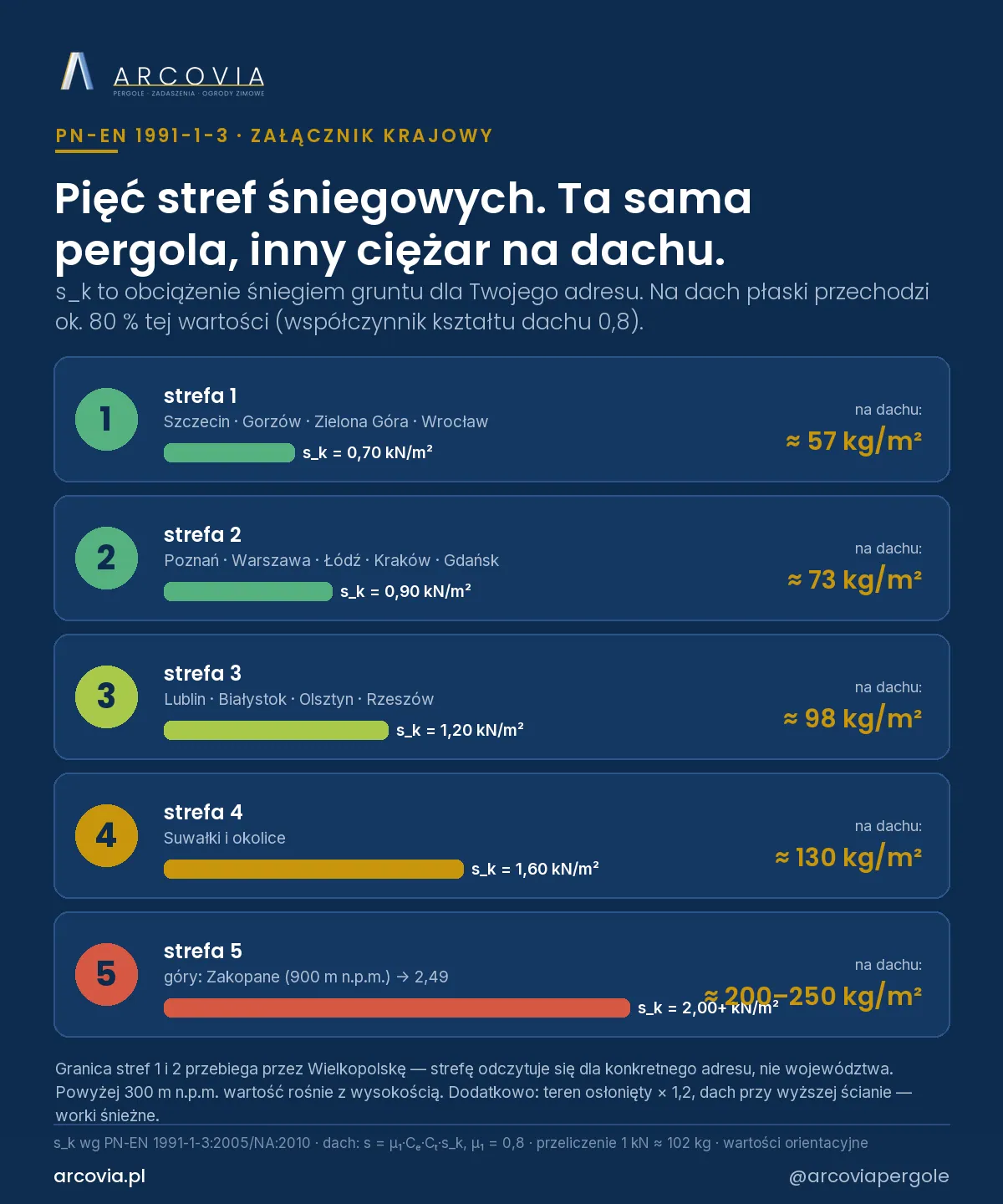
Not all of s_k reaches the roof. For a flat or gently sloping roof the standard adopts a shape coefficient of 0.8, because part of the snow is blown off. In zone 2, where Poznań, Warsaw and Łódź lie, this gives 0.72 kN/m², that is, about 73 kg on every square metre of roof. One conversion is worth remembering: 1 kN is approximately 102 kg. In our first article on the blog we rounded this to 100 kg, which is why it came out at 865 kg for a 4 × 3 m pergola there, and today it comes out at 881 kg. It is the same figure, rounded differently.
Two remarks that matter in Wielkopolska:
- The boundary between zones 1 and 2 runs through our voivodeship. The zone is read for a specific address, not for the voivodeship. Anyone who gives the zone “by eye” has not calculated.
- The surroundings change the result. A roof sheltered from the wind, for example squeezed between the house and a tall hedge, gets an exposure coefficient of 1.2. Instead of 73 kg/m² it becomes 88. And a roof next to a taller building wall additionally collects so-called snow pockets, that is, drifts blown from above.
Now let us convert this into something you can picture.
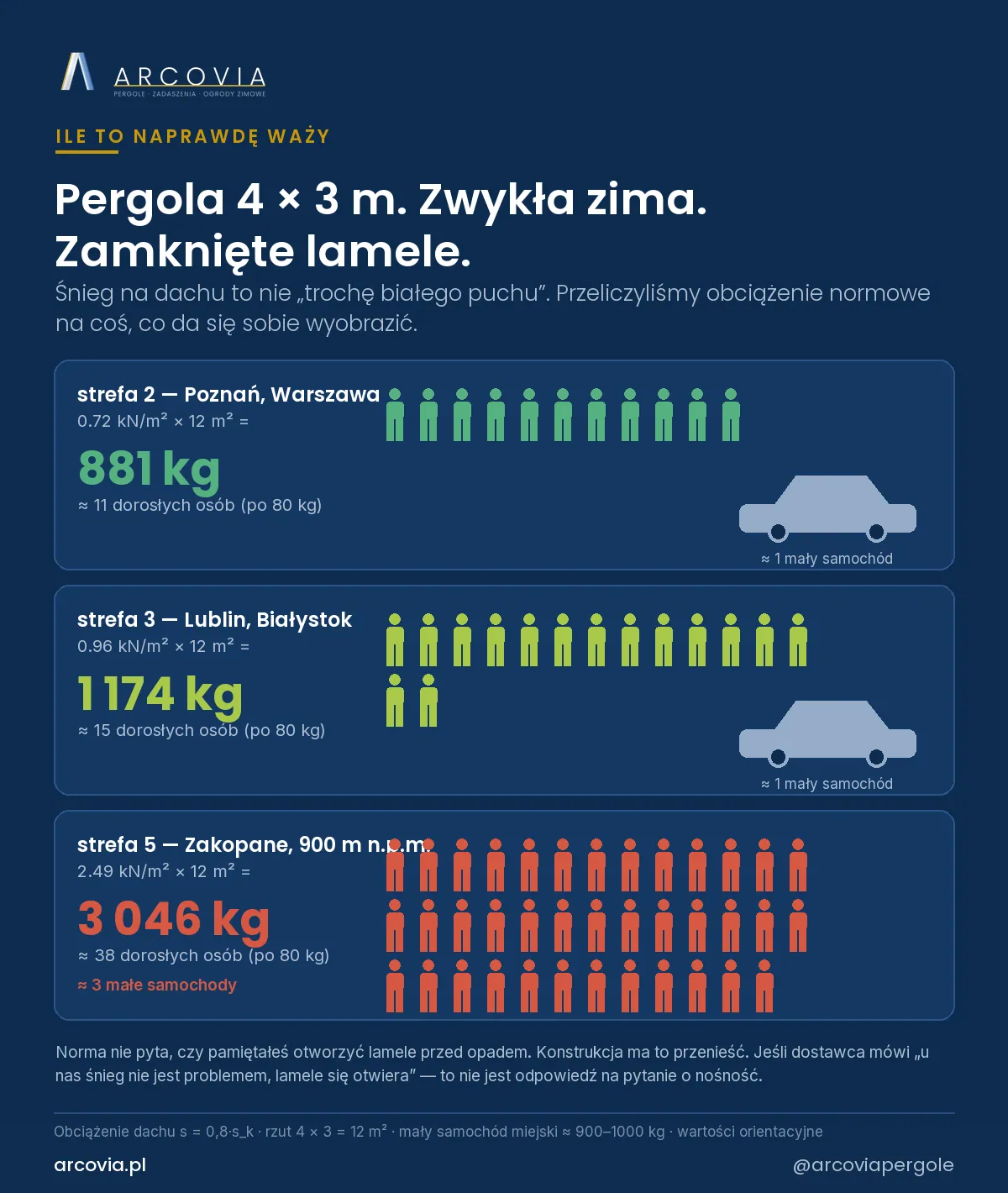
In zone 2 that is 881 kg, or eleven adults standing on your roof. In Zakopane, over three tonnes. The standard does not ask whether you remembered to open the louvres before the snowfall. The structure has to carry this weight in the worst case, because the worst case is an ordinary snowy weekend when you are away skiing.
Wind: it is not pressure, it is suction
Wind is more interesting, because it acts the opposite way to what intuition suggests. It seems that the wind pushes against the roof and presses it down onto the posts. In reality, above an open roof the air accelerates and negative pressure forms, exactly as above an aircraft wing. The wind lifts the roof.
The basis is the wind velocity pressure for the wind zone. Most of Poland, including the whole of Greater Poland, lies in zone 1. The coastal belt is zone 2, the mountains are zone 3. On top of that comes the terrain category: the same town, but with open fields behind the house or dense development, gives a different pressure at the height of the pergola roof.
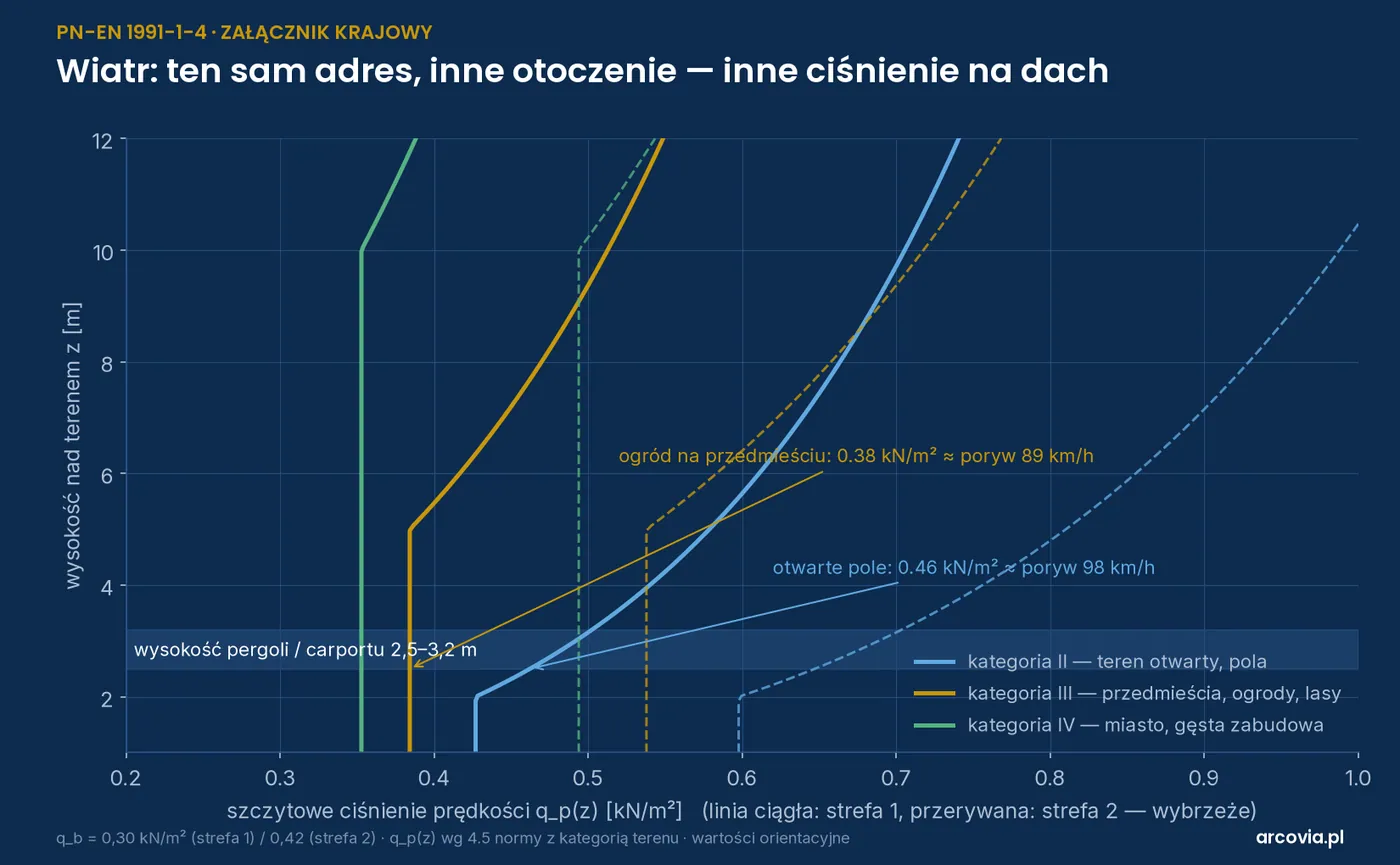
For a garden on the outskirts of Poznań, at a height of 2.5 m, the pressure is about 0.38 kN/m². That corresponds to a gust of the order of 90 km/h. In open country it is already 0.46 kN/m². These are not extreme values. Such gusts occur in Greater Poland several times a year.
What matters, however, is not the gust itself but how the canopy responds to it. The standard describes this with the coefficient c_p,net. For open canopies such as a pergola or carport, it reaches minus 1.3 in the edge zones. Minus means suction, pulling upwards. Multiplied out, this gives about 0.50 kN/m² of uplift force on the roof.
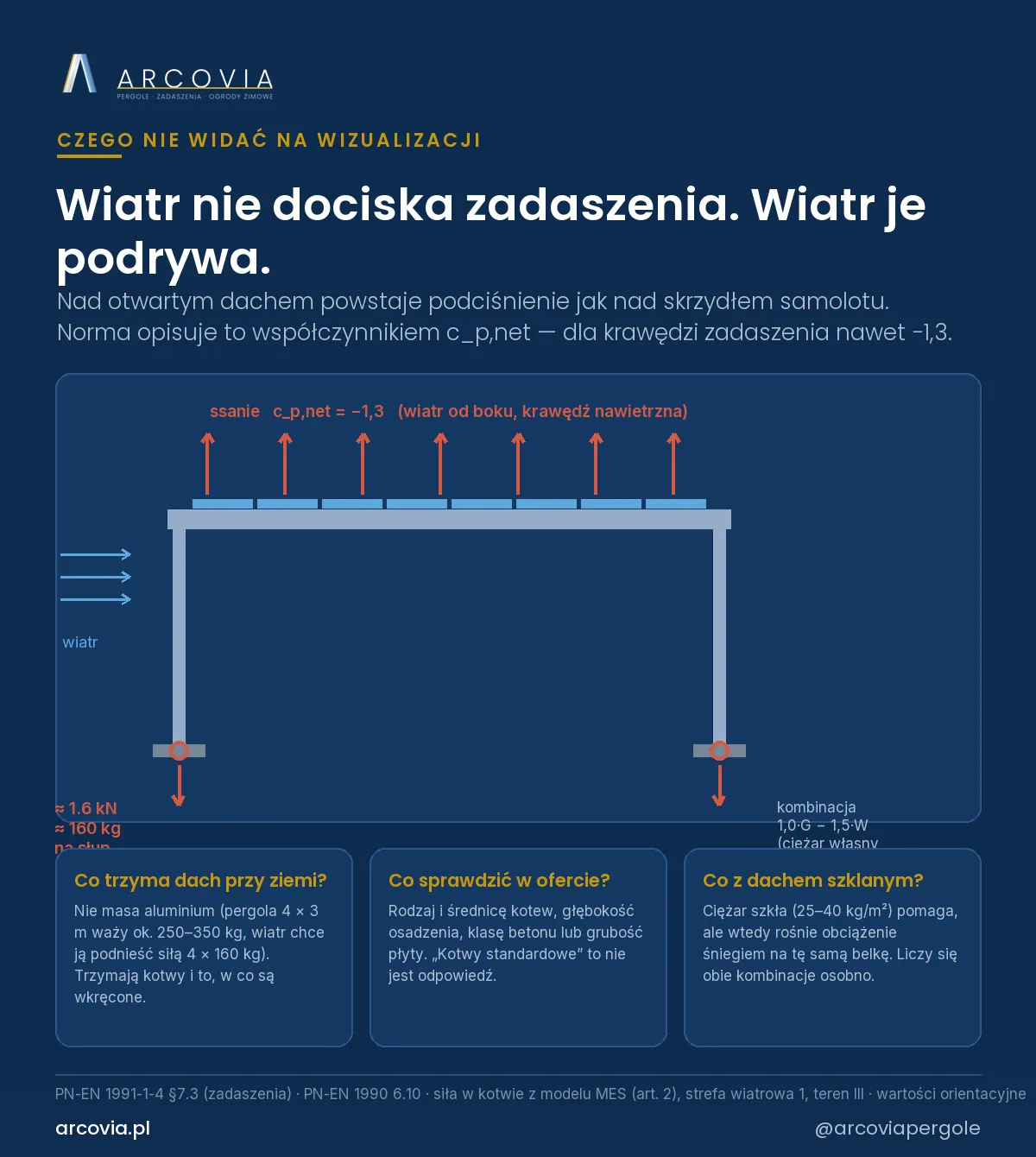
For our 4 × 3 m pergola this comes to about 1.6 kN, that is 160 kg of uplift force on each post. The whole pergola weighs 250–350 kg, so each post carries 60–90 kg of self-weight. The weight of the structure alone will not hold the roof down. The anchors will, together with whatever they are fixed into. We return to this in the third part, because the foundation is where quotations most often fall apart.
How it all combines: load combinations
Snow, wind and self-weight do not act separately. The standard PN-EN 1990 says how to combine them and what margin to apply. In practice, three cases matter for a canopy:
- Load capacity under snow: 1.35 times self-weight plus 1.5 times snow. These multipliers are a safety margin built into the standard, not into a salesman’s promise.
- Deflection under snow: self-weight plus snow, with no multipliers, because we are checking whether the beam sags in a way that is visible and harmful to the louvres.
- Uplift by wind: 1.0 times self-weight minus 1.5 times wind. Here the self-weight is “on our side”, so it must not be overstated.
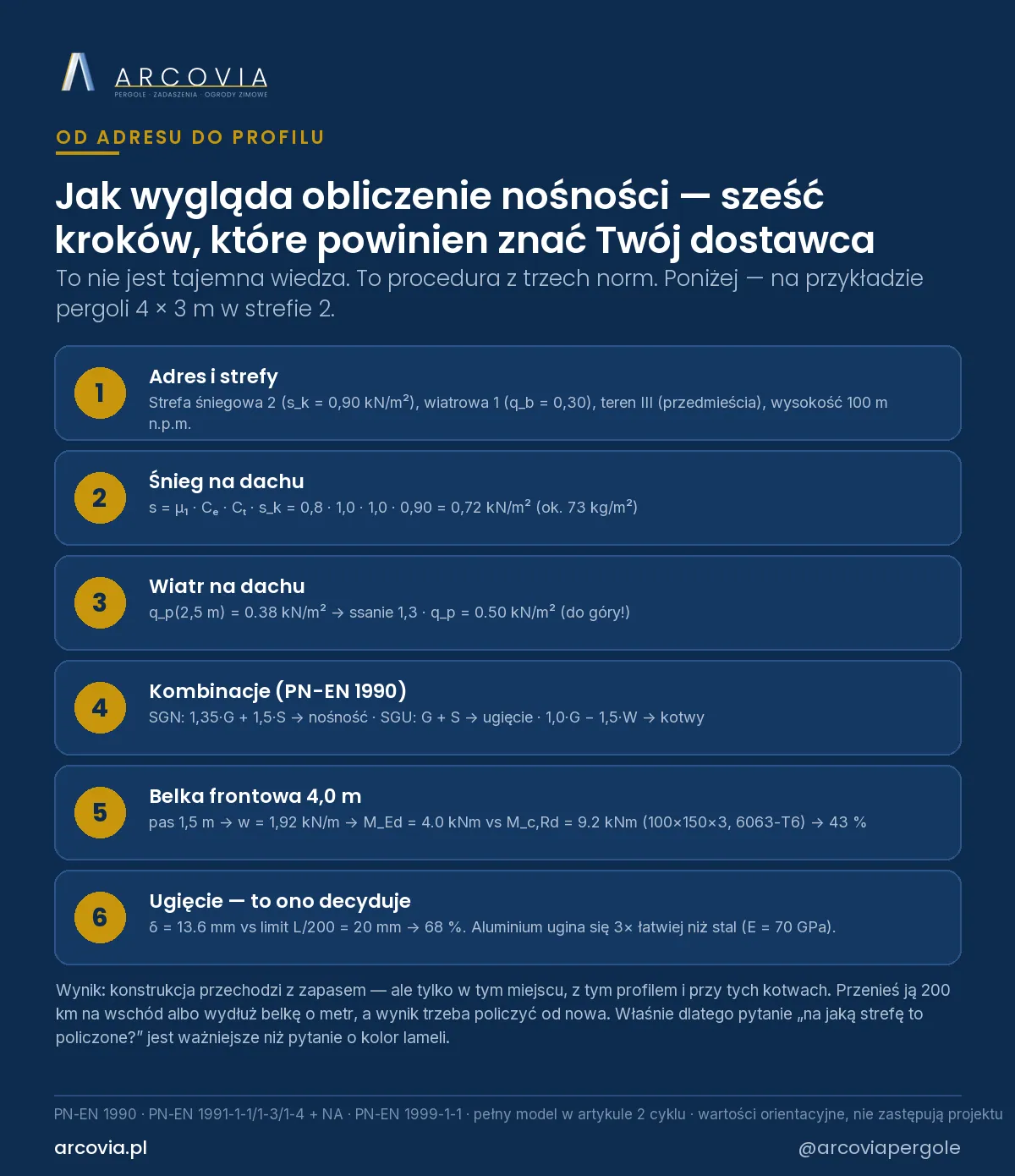
The graphic shows the whole procedure using a 4 × 3 m pergola in zone 2 as the example. The front beam, 4 m long with a 100 × 150 × 3 mm section, carries the bending moment at 43 % of its capacity. That is a good result. But something else decides the choice of profile.
Deflection: aluminium yields before it breaks
Aluminium has a modulus of elasticity of about 70 GPa, one third of the value for steel. An aluminium profile that carries the load with ease can still deflect noticeably. For canopies the permissible deflection is usually taken as 1/200 of the span. For a 4 m beam that is 20 mm. Our beam deflects by 13.6 mm under snow, using 68 % of the limit. Load capacity 43 %, deflection 68 %: it is deflection, not strength, that decides the profile.
Why does this matter to the buyer? Because a “reinforced profile” in a brochure usually means a thicker wall. And wall thickness has little effect on deflection. What counts is the depth of the profile, to the third power. We show this on a chart in the second part.
For the curious. Snow on the roof: s = μ₁ · Cₑ · Cₜ · s_k, where μ₁ = 0.8 for roofs with a pitch of up to 30°, Cₑ = 1.0 for normal terrain (1.2 sheltered), Cₜ = 1.0. Wind: peak velocity pressure q_p(z) according to clause 4.5 of PN-EN 1991-1-4, with a base value of 0.30 kN/m² for zone 1; net force on the canopy w = q_p · c_p,net. Beam resistance: M_c,Rd = W_el · f_o / γ_M1, with f_o = 160 MPa for alloy 6063-T6 and γ_M1 = 1.10. Deflection of a simply supported beam: δ = 5 · w · L⁴ / (384 · E · I). All values in this series are indicative and do not replace a structural design for a specific project.
What this means for you
- Ask about the zone. A supplier who has calculated the structure will give you the snow zone, the wind zone and the terrain category for your address without looking at notes. Anyone who answers “snow is not a problem in Poland” has not done the calculation.
- Ask about deflection, not strength. The question “how many millimetres will the beam deflect under snow, and what limit was assumed” immediately shows whether there is an engineer or a brochure on the other side.
- Ask about the anchors. If the wind wants to pull 160 kg out of every post, someone had to select an anchor that will carry that. “Anchors included” is not an answer.
How we work
At Arcovia, calculating the loads is not an additional service but the first step of the quotation. We attach our assumptions to every offer: the snow zone and wind zone for the installation address, the terrain category, the selected profiles, the result of the load capacity and deflection check, and the method of anchoring. The technical director, Andrzej Polski, is responsible for this part, by name. We believe these figures should be an annex to the quotation, not the contractor’s secret.
If you would like to know which zone your house lies in and how much snow we will assume for your terrace, write to us or call: +48 690 533 609. Checking the zone for an address is free of charge.
Frequently asked questions
Which snow zone is Poznań in?
Poznań and most of Greater Poland lie in zone 2, where the characteristic ground snow load is 0.90 kN/m². The western edge of the voivodeship, near the border with Lubusz Voivodeship, belongs to zone 1 (0.70 kN/m²). The zone is read from the map in the National Annex to PN-EN 1991-1-3 for the specific address.
Does a pergola with openable louvres have to be calculated for snow?
Yes. The standard does not assume that the user will manage to open the louvres before snowfall. The structure must carry the full snow load for its zone with the roof closed. Opening the louvres for winter is good practice, but it does not replace the calculation.
How much does snow weigh on a 4 × 3 m pergola?
In zone 2 about 880 kg with the louvres closed, in zone 3 about 1 170 kg, and in the mountains more than 3 tonnes. These are standard values for an exceptionally snowy winter, not averages. Wet snow weighs more than powder, which is why the standard specifies a load rather than a depth of cover.
Can the wind tear off a pergola?
It can, if it is poorly anchored. On an open canopy the wind causes upward suction, which for a 4 × 3 m pergola gives about 160 kg of uplift force on each post. The mass of the structure does not balance this. Safety depends on the anchors and the substrate they are set in.
Is a carport calculated in the same way as a pergola?
Yes, it is the same type of structure within the meaning of the standard: an open canopy. A carport usually has a longer span and a stiffer covering, so the snow load is greater and beam deflection matters even more. The rules, zones and combinations remain the same.
In the next part: we take the same 4 × 3 m pergola, build its calculation model and show, step by step, what snow and wind do to the beam, posts and anchors. With charts of deformation and moments, and a comparison of five locations in Poland. Published next week.
Next post: Winter garden, summer garden or pergola? Three different structures, three different consequences